A cohort-based workshop, The Design Emerge is designed to foster design thinking from a non-designer's perspective. It aims to elevate freshers and junior designers by encouraging them to integrate cultural and natural influences into their work. The program emphasizes inclusivity, promoting local design thinking in the intersection of communication and product design.
If I'm capable of designing, so are you 🙌
Embark on an eight-session journey. This design workshop builds a solid foundation, enabling you to approach diverse challenges with a design-centric mindset. Bring your vision to life by creating a personal design project through the workshop.
Design Emerge
If I'm capable of designing, so are you
A cohort workshop for anyone who assumes design is beyond them. Eight sessions, twenty-four hours live, and you finish it with a project of your own. ₹999, payable after it ends and only if it was worth it. If the fee is what is in your way, ask for a free seat and tell me why.
◎
Sessions
8
◷
Hours live
24
₹
Fees
₹999 or Free
Pay after the workshop, or ask for a free seat.
文
Language
Bengali, English, Hindi, Nepali
Whichever of the four the cohort thinks in.
↔
Format
Available online and offline
Join the live online cohort from anywhere, or bring Design Emerge to your team, campus or community in person.
I have taken this year off from teaching, and applications are open now. Bengali and Hindi sit on Sundays and open that day. Nepali and English sit on Saturdays, so their first sitting is the 27th, the Saturday of the same week. Apply whenever you like and I will hold your place.
About facilitator
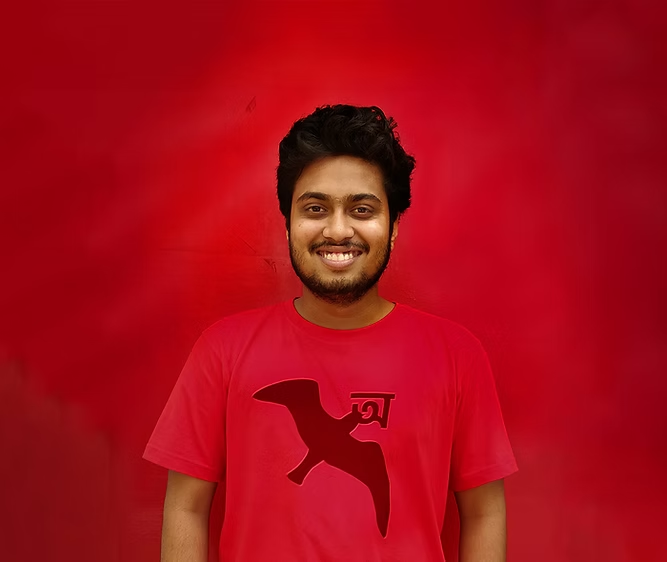
I'm Rabiul Islam, also known as Rabi, and I come from the rural regions of Bengal. I have been pursuing a career in Communication (+Product) Design for the last 8 years.
I've worked with 100+ brands in different fields of design. I have facilitated 260+ people and mentored 32+ visual designers. I aspire to democratise design education, making it accessible to everyone. As a step towards this goal, I've organised this online design workshop (live Sessions).
Years in practice
8+
Brands worked with
100+
People facilitated
260+
Designers mentored
32+
Who is this for
01
Non-designers
Design enthusiasts and non-designers who may feel design is beyond their expertise.
02
Consultants
Consultants seeking to enhance their presentation skills.
03
Aspiring designers
Young individuals with aspirations of becoming visual designers and UI/UX designers.
04
Researchers
Social science researchers conveying complex ideas through graphs and charts.
05
Volunteers & interns
Anyone making engaging social media posts on a daily basis.
Fees & waiver
₹
₹999 after the workshop, or free if you need it free.
Nothing is due before it starts, and nothing is due while it runs. At the end, if it was worth it, you pay. If it was not, you do not, and I would rather hear why.
♥
Asking for a free seat
If the fee is the thing standing in your way, say so and take a free seat. I only ask for two things in writing: how this workshop will help you, and why you need it free. A hundred to a hundred and fifty words, in whatever language you think in. I read every one of them, and I do not ask anyone to prove they are poor.
Workshop curriculum
Eight sessions. A collaborative learning and creative endeavour aimed at grasping the core
principles of design, nurturing a design-centric dialogue through storytelling, and shaping
design projects.
Format
One live session at a time, in Bengali, English, Hindi or Nepali, with room between them to work on a project of your own.
Session 1Intro of designThis is a collaborative learning and creative endeavor aimed at grasping the core principles of design, nurturing a design-centric dialogue through storytelling, and shaping design projects.
Session 2Functionality & limitation of expressionExpressing human emotions through basic design elements, and understanding the limitations and delimitations of language and representation.+ Basic understanding of design tools like Illustrator, Photoshop, Figma
Session 3Emotion & typographyAnatomy of typography and basic understanding of typesetting in crafting layouts. Typography and minimal design.+ Practicing typography in Illustrator
Session 4EmpathyWhat is empathy, and how does it help in design? Influence of culture and nature in design. Listening and not listening in individual and collective discourse. Inclusive design. Identifying problems.
Session 5Framing the challengeTurning what you have noticed into a problem statement you can design against, and choosing the project you will carry through the rest of the workshop.
Session 6Approaching it through designWorking the problem out loud: references, directions, and the first rough attempts. Mentorship on where each individual project is going.+ One to one on your project
Session 7Tools & craftGuidance for design tools and software, worked on your own project rather than on an exercise, so the craft arrives where it is needed.+ Illustrator, Photoshop, Figma
Session 8Wrap upPresenting individual projects and reflections. Portfolio making and marketing your design work.+ Feedback
Day one4 sessions
The ground: design, expression, type, empathy
Session 1Intro of designThis is a collaborative learning and creative endeavor aimed at grasping the core principles of design, nurturing a design-centric dialogue through storytelling, and shaping design projects.
Session 2Functionality & limitation of expressionExpressing human emotions through basic design elements, and understanding the limitations and delimitations of language and representation.+ Basic understanding of design tools like Illustrator, Photoshop, Figma
Session 3Emotion & typographyAnatomy of typography and basic understanding of typesetting in crafting layouts. Typography and minimal design.+ Practicing typography in Illustrator
Session 4EmpathyWhat is empathy, and how does it help in design? Influence of culture and nature in design. Listening and not listening in individual and collective discourse. Inclusive design. Identifying problems.
Day two4 sessions
The project: framing, making, craft, presenting
Session 5Framing the challengeTurning what you have noticed into a problem statement you can design against, and choosing the project you will carry through the rest of the workshop.
Session 6Approaching it through designWorking the problem out loud: references, directions, and the first rough attempts. Mentorship on where each individual project is going.+ One to one on your project
Session 7Tools & craftGuidance for design tools and software, worked on your own project rather than on an exercise, so the craft arrives where it is needed.+ Illustrator, Photoshop, Figma
Session 8Wrap upPresenting individual projects and reflections. Portfolio making and marketing your design work.+ Feedback
Being creative inside an AI design framework
A day for a team that has the tools already and is not sure what its own judgement is worth any more. We work on your briefs, not on made-up ones, and the day ends with something the team can use on Monday.
Six hours in one day. Three hours, a long break, three hours. Short pauses inside each half.
First half3 hours
What the machine is actually doing, and what is still yours
Where the creative work moved toA model will make the artefact. It will not decide what is worth making, who it is for, or what would be wrong to make. We go through what has actually shifted in a design process and what has only appeared to.
The brief is the design problem nowWriting an instruction well is the same skill as writing a brief well: knowing the constraint, the audience and the thing you are refusing to do. We take briefs your team has really been given and work them until the output stops being generic.
The break in the middle is a real one, long enough to eat. The day does not work if it is a sprint.
Second half3 hours
Making, and then judging what came back
Hands on your own workThe team works a live piece through the tools it already has, together, out loud. I am there for the parts that go wrong, which is where the learning is.
Taste, editing and what you are willing to shipThe hard part is not generating forty options. It is knowing which one is right and being able to say why to somebody who disagrees. We end on how the team decides, and what it will not put its name to.
Priced for the team rather than per seat, and it depends on the size of the group and how much of it runs on your own live work. Tell me both and I will quote.
Apply for a seat
One form for all three. Tell me which one you want and, if you are asking for a free seat,
why. I read every application myself, and I reply to all of them.
Upcoming cohorts
NepaliMorningSaturdays, 7:00 to 10:00 am ISTFirst sitting 27 February 2027
BengaliMorningSundays, 7:00 to 10:00 am ISTFirst sitting 21 February 2027
EnglishEveningSaturdays, 7:00 to 10:00 pm ISTFirst sitting 27 February 2027
HindiEveningSundays, 7:00 to 10:00 pm ISTFirst sitting 21 February 2027
Each language keeps one hour for the whole run, so the week never has to be checked. Eight sessions, three hours each, one a week. If none of the four suits you, say so in the application and I will put you on the next round.