AI/ML science communication with AIcrowd
Making machine learning challenges legible: one picture per problem, for competitions run at NeurIPS, CVPR, ICCV and ISMIR.
The problem
A challenge arrives as a paragraph of research language and a dataset. It has to leave as something a person will stop scrolling for, without misrepresenting the science underneath it.
- Platform
- Challenge platform, social and link previews
- Timeline
- 2020 to 2024
- My role
- Science communication, art direction, design
- Made at
- AIcrowd
-
Rule
The picture carries the problem rather than decorating it. No stock circuit boards, no glowing brains. Where a field already has an object that means something to its people, the design uses that object.
-
Method
The clock a clinician asks a patient to draw; the dataset’s own column names; the pose skeleton a researcher sees in their annotations. Recognition does the work a headline cannot.
-
Series
For multi-part events, one scene held constant and one element changed per task, so five puzzles read as five parts of one thing.
Outcome
30+ challenges for NeurIPS, CVPR, ICCV, ISMIR and KDD Cup among others, with roughly 800,000 views counted by the platform itself across the ones shown here.
AIcrowd runs open machine learning challenges. A challenge arrives as a paragraph of research language and a dataset, and it has to leave as something a person will stop scrolling for. That is the whole brief.
The rule I worked to was that the picture has to carry the problem, not decorate it. No stock circuit boards, no glowing brains, no blue hexagons. Where a field already has an object that means something to the people in it, the design uses that object: the clock a clinician asks a patient to draw, the column names of the dataset, the pose skeleton a researcher will actually see in their own annotations.
Almost none of these were AIcrowd’s alone. A challenge is run with the group that owns the problem and the data, and the work was made at AIcrowd for them: the Alzheimer’s Disease Data Initiative on clock drawings, OpenAI on generalisation, Sony on demixing, the University of Saskatchewan on wheat, the MABe team on mouse behaviour, ZEW on data purchasing, Amazon on shopping queries. Whose challenge it is decides the register the picture is allowed to use, which is why the wheat is lettered for agronomists and the Alzheimer’s banner refuses to be excited about itself. Each panel below names both.
The set below runs in order, each with a note on what that particular problem was and why it was drawn the way it was.
The work, one at a time
ADDI Alzheimer’s Detection Challenge
Art direction
The banner refuses the usual brain scan and uses the instrument itself. A clock face disperses into particles from the right, and beneath it a line of figures walks left to right through a whole life, child to stooped elder with a stick, the last of them already inside the dispersal. Two things are being lost at once and they are drawn as one event. The prize list underneath is deliberately plain: this is a medical problem and the design should not be excited about it.
Science communication
Early Alzheimer’s is screened with the clock-drawing test: a patient is asked to draw a clock showing a given time, and what a clinician reads is not the clock but the way the drawing fails. Numbers crowd into one quadrant, hands go missing, the circle does not close.
NeurIPS 2020: Procgen Competition
Art direction
The subject has no natural picture, so the picture is ascent. Sixteen procedurally generated worlds, each a real frame from the benchmark, are stacked into a rising staircase and the agent climbs it, so the sample efficiency and the generalisation named in the subhead are the same movement upward. The frames are shown as themselves rather than stylised, because a researcher recognises the environments and that recognition is the fastest way to say this challenge is yours. Run with OpenAI, whose mark sits beside AIcrowd’s at the same weight.
Science communication
Procgen asks a narrow, difficult question: can an agent that has mastered some levels of a game handle levels it has never seen? The subject is generalisation.
NeurIPS 2021 AWS DeepRacer AI Driving Olympics
Art direction
The image is one continuous road that begins as a wireframe mesh, the way a simulator renders ground, and then lifts off that mesh and curls upward into open space, solid and lit, with the car at the point of transition. Nothing else moves. Sim-to-real is usually explained in a paragraph; here it is one line going up off its own grid.
Science communication
The hard part of this challenge is the sim-to-real gap: a policy is trained in simulation and then has to drive a physical car on a physical track, where friction and light and tyre wear are all real.
Music Demixing Challenge, ISMIR 2021
Art direction
The drawing runs the process backwards so it can be read in one glance. A single unbroken white line starts as a treble clef and, moving along its own length, comes apart into a snare, a piano, a horn, a cymbal, until the notation has become the instruments it stood for. One line, because the point is that the mix is one signal until a model pulls it apart. Sony’s mark sits with AIcrowd’s and ISMIR’s on a deep navy, which is the concert-hall end of the palette rather than the laboratory end.
Science communication
Demixing takes a finished stereo track and separates it back into stems: vocals, bass, drums, everything else.
Global Wheat Challenge 2021
Art direction
The design leaves the computer vision register alone entirely. One ear of wheat in solid black, drawn with the awns spread, and a title lettered with a flourish the way a mark is stencilled on a grain sack or printed on a seed packet. It looks like agriculture, which is the audience it needs to reach, and the black ear reproduces at any size down to a favicon.
Science communication
Detect and count wheat heads in photographs of real fields, across continents, cultivars and light conditions. It is an ICCV challenge, but the people who care about the answer include agronomists and breeders.
Multi-Agent Behavior, CVPR 2021
Art direction
The banner shows exactly what a researcher will be looking at and nothing more: two animals, one white and one black, on the flat grey of a cage floor, with the tracked pose skeleton drawn over each in dotted line and a red mark at the nose. No abstraction, no neural network diagram. Someone who has annotated this data recognises their own working view, and that recognition does more than a headline could.
Science communication
The dataset is video of pairs of mice interacting, annotated frame by frame by trained observers, and the task is to represent and classify what the animals are doing.
WINEQ, predict wine quality
Art direction
The picture teaches while it announces. The glass is drawn entirely out of the dataset’s own column names, fixed acidity and volatile acidity and citric acid and residual sugar and chlorides, the words curving to make the bowl and the stem. A newcomer learns what a feature is, and that this wine is nothing but its features, before opening the notebook. Set on AIcrowd’s red, because this one is the house’s own.
Science communication
A first tabular problem: predict a wine’s quality score from eleven chemical measurements. The audience is people who have not done this before.
Multi-Agent Behavior Challenge 2022
Art direction
The mice and the flies here are not drawn and then covered in dots: they are built out of the keypoints, so each animal exists only as the tracked points a model would ever receive, and the eye assembles the creature the way the model has to. It is as close as a still image gets to showing the machine’s view rather than ours, and it makes the year-on-year jump legible: 2021 showed the annotation, 2022 shows the representation. Northwestern, Google, Amazon and Janelia across the top.
Science communication
The next year of the same challenge, now learning behavioural representations from animal poses in video.
Data Purchasing Challenge 2022
Art direction
The image is a balance, tipped. A purse sits on one pan and on the other a spray of unlabelled points fans up and falls back into the dish, the quantity you might buy. What is being weighed is money against information, and a scale states that trade in the second the picture gets before someone scrolls past. Run for the Leibniz Centre for European Economic Research.
Science communication
This one is an economics problem wearing machine learning clothes: given a fixed budget, which unlabelled data should you pay to have labelled? Nothing about model architecture will answer it.
AI Blitz XI, five puzzles in twenty-one days
Art direction
There is one scene and it never changes. A toy car on a cut-paper road, the same camera angle, the same yellow and orange, every time. Each puzzle then alters exactly one element. Rain falling with ripples spreading on the road for environment classification. A radar ring around the car and a bird crossing it for lidar detection. A red bounding box drawn on a balloon seller for object detection, and the same box on a cat for obstacle prediction. Colour mapped across the terrain in flat bands for scene segmentation. The constant scene is what makes the difference legible, and the toy is what makes an autonomous driving benchmark approachable to someone taking their first one.
Science communication
Five self-driving puzzles run as a single event, which is a communication problem before it is a design one: they have to read as five parts of one thing rather than five separate competitions, and each has to be understood on its own in about a second.
Amazon KDD Cup 2024, multi-task online shopping for LLMs
Art direction
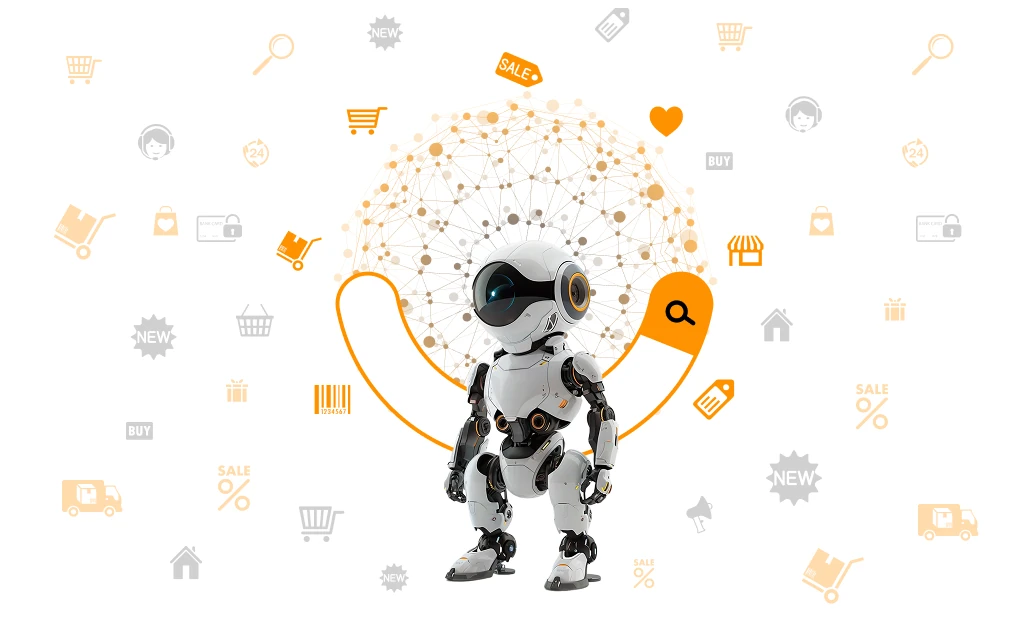
No single object depicts four jobs at once, so the composition splits the work between subject and ground. The subject is a shopping bag whose handle is Amazon’s own arrow, whose body is a knowledge graph of connected nodes, and whose tab is a search field, with the assistant standing inside it as though the bag were the shop. The ground is the tasks themselves, drawn faintly and evenly across the whole board: carts, price tags, barcodes, storefronts, a delivery van, a returns mark, a headset for support. In focus, the thing doing the work; behind it, everything it is expected to do. This became the most seen of the set by a distance.
Science communication
The word carrying this title is multi-task: one language model has to answer product questions, rank results, reason about a basket and hold a conversation, all inside the same shop.
Credits
- Client AIcrowd
- Concept and design Rabi [Rabiul Islam]
- Partner collaboration Sneha
- Special thanks Mr. Mohanty, CEO of AIcrowd